
Erasmus+ is the European Union's programme for education, training, youth, and sport, running from 2021 to 2027 with an estimated budget of 26.2 billion euros. Since its founding in 1987, the programme has supported over 16 million participants across Europe and beyond. But what does joining an Erasmus course actually do for you? Whether you are an educator, a project manager, or an institutional leader, structured Erasmus+ training courses deliver measurable gains in intercultural competence, career prospects, and classroom effectiveness. This guide breaks down the key benefits and shows how to make the most of them.
What Are Erasmus Courses?
Erasmus courses are structured professional development programmes funded under the Erasmus+ framework. They are designed to help individuals and organisations improve skills, share good practices, and strengthen the quality of education and training. Under KA1 mobility, staff from accredited organisations travel abroad for training, job shadowing, or teaching assignments.
Providers like Alfa Edu specialise exclusively in Erasmus+ and EU-funded education, offering hands-on courses in Rome that cover everything from project implementation to early childhood teaching strategies. These are available to EU-accredited organisations, not individual private learners.
Professional Benefits: Career Skills and Employability
The professional impact of Erasmus participation is backed by hard data. A European Commission study found that 80% of Erasmus participants found a job within three months of graduating. For 72% of them, their Erasmus experience was crucial in securing that first position. Even a decade later, 70% of former participants held executive positions in their companies, according to the same research summary.
Practical Classroom and Management Skills
Erasmus courses go beyond theory. At Alfa Edu, for instance, the Mastering Erasmus+ Project Implementation course teaches coordinators how to manage grant agreements, partner contracts, budgets, and mobility workflows. Participants leave with practical templates ready for immediate use.
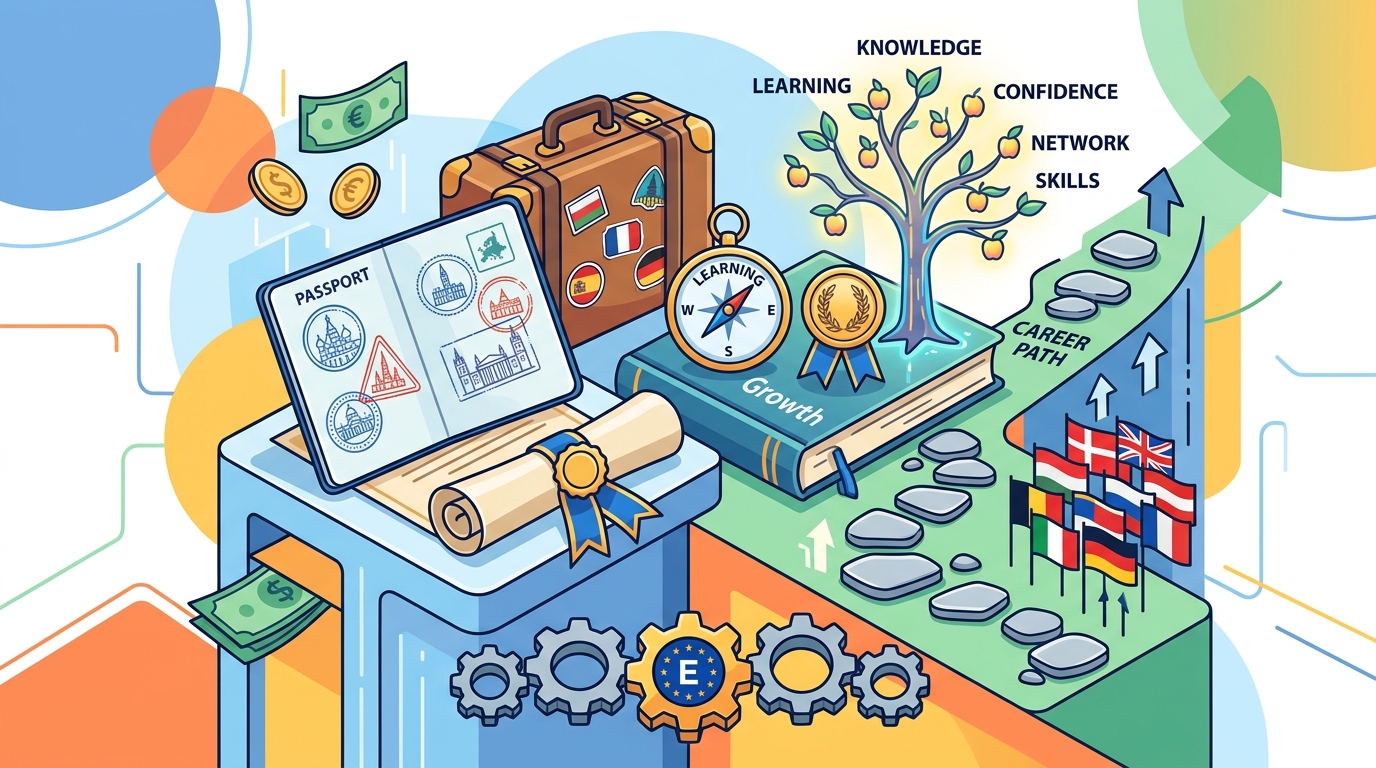
Improved Employability Metrics
The unemployment rate among former Erasmus participants is 23% lower than their non-participating peers. Nine out of ten employees say the skills they acquired during their Erasmus period are used in their everyday duties. These are not marginal differences; they represent a structural advantage in the labour market.
Personal Growth: Confidence, Adaptability, and Perspective
Personal development is one of the most widely reported outcomes. Over 70% of former Erasmus participants said they had a much clearer vision of their career direction after returning home. Stepping out of familiar surroundings forces participants to solve problems independently and adapt quickly.
Adaptability is the capacity to adjust behaviour and thinking in response to new environments. Erasmus courses cultivate it by placing participants in multicultural, experiential learning settings. At Alfa Edu, courses are designed to immerse learners in unconventional, experience-driven learning that connects skills to real life.
Self-Confidence and Independence
Research published in PMC confirms that Erasmus participants frequently report a boost in self-confidence, character development, and learning independence. One respondent described the benefits as related to "the evolution of consciousness, character, and horizons."
Building Intercultural Competence
Intercultural competence is the ability to communicate and collaborate effectively across cultural boundaries. Erasmus mobility is specifically designed to build this skill. The Erasmus+ Programme Guide highlights that the programme equips participants with qualifications and skills needed for intercultural understanding and meaningful participation in democratic society.
Employers increasingly value this trait. Research shows that employers recognise the agility and open-mindedness that mobility programme participants develop. In a globalised job market, this is not a soft skill; it is a competitive necessity.
Language Skills and Communication
Language improvement is the single most reported benefit. A study of medical students who completed Erasmus exchanges found that 94% reported improved professional foreign language skills, with 77% describing the improvement as significant. The Erasmus+ programme supports this through the Online Language Support (OLS) platform, providing e-learning tools before, during, and after mobility.
Stronger language skills translate directly into better collaboration in international teams, more effective teaching, and broader career mobility across European borders.
Networking and International Collaboration
Erasmus courses create lasting professional networks. Alfa Edu's courses, for example, build a European peer network that supports future collaboration. These connections often lead to joint project proposals, knowledge exchanges, and long-term institutional partnerships.
Through international projects, organisations bring together ideas, cultures, and expertise to create meaningful impact. Networking during structured courses is not accidental; it is a designed outcome of the Erasmus+ framework.
Benefits at a Glance: Before vs. After Erasmus
| Dimension | Before Erasmus Participation | After Erasmus Participation |
|---|---|---|
| Career Clarity | Uncertain direction | 70%+ report clearer career vision |
| Employability | Standard graduate prospects | 80% employed within 3 months |
| Unemployment Rate | National average | 23% lower than peers |
| Language Proficiency | Basic or intermediate | 94% report improvement |
| Executive Positions (10 yr) | Baseline rate | 70% hold executive roles |
| International Network | Limited or local | Pan-European peer connections |
| Self-Confidence | Variable | Significant boost reported widely |
Key Takeaways
- Erasmus+ courses deliver measurable career advantages, including a 23% lower unemployment rate and faster job placement after graduation.
- Personal growth outcomes include greater self-confidence, adaptability, and a clearer career vision for over 70% of participants.
- Language skills improve for 94% of participants, making them more effective in international and multicultural settings.
- Intercultural competence built through Erasmus mobility is valued by employers as a competitive differentiator.
- Structured courses from specialised providers like Alfa Edu offer practical tools, templates, and peer networks ready for immediate professional use.
- The Erasmus+ programme (2021-2027) has a budget of 26.2 billion euros and supports education, training, youth, and sport.
- Networking during Erasmus courses often leads to lasting institutional partnerships and joint projects across borders.
Frequently Asked Questions
What is an Erasmus course?
An Erasmus course is a structured training programme funded under the Erasmus+ framework, designed to develop professional and personal skills through international mobility experiences. Providers such as Alfa Edu deliver these courses for EU-accredited organisations.
Who can participate in Erasmus+ training courses?
Erasmus+ training courses under KA1 are available to staff from organisations that hold valid Erasmus+ accreditation or have an approved KA1 project. They are not open to individual private learners.
How do Erasmus courses benefit my career?
Research shows that 80% of Erasmus participants secure employment within three months of graduating, and 72% credit the experience as crucial for landing their first job. Skills gained are used daily by 9 out of 10 professionals.
Do Erasmus courses improve language skills?
Yes. Studies show that 94% of Erasmus participants report improved foreign language proficiency. The programme also provides the Online Language Support platform for additional learning.
How long do Erasmus training courses last?
Duration varies by provider and course type. Alfa Edu's courses in Rome typically run for 6 days, combining classroom-based training with cultural exploration and networking.
What topics do Erasmus courses cover?
Topics range widely, from Erasmus+ KA1 application writing and project implementation to early childhood education, critical thinking, and communication strategies.
How do I apply for an Erasmus+ KA1 course?
Your organisation must first register for an Organisation ID (OID) and either hold Erasmus+ accreditation or submit a successful KA1 application. Then you select a course provider and include the activity in your mobility plan. Learn more about how to apply step by step.
Are Erasmus courses only for teachers?
No. While many courses target educators, the programme also serves school administrators, project managers, NGO professionals, and adult education staff. The scope extends across all education and training sectors.
Your Next Step
Ready to unlock the professional and personal benefits of Erasmus+ training? Explore the full catalogue of Erasmus courses at Alfa Edu and request information on upcoming sessions in Rome. Your growth starts with one decision.